In gear manufacturing, there is a wide range of methods used to create the precise tooth profiles and geometry a gear needs to perform. Among them, gear shaping and gear hobbing are two established gear-cutting processes used across industrial manufacturing, with each suited to different types of parts and production needs.
Although both processes produce gear teeth, they approach the job differently. The tools, cutting motions, and types of gear configurations each process offers all play a role in how they are used.
In this guide, we’ll look at how gear hobbing and gear shaping work, the key differences between them, and the types of gears and applications each process is commonly used for.
Gear Hobbing: How It Works & Where It’s Used
How Does Gear Hobbing Work?
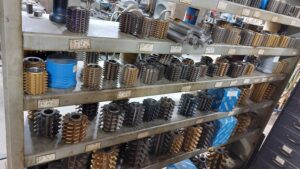
Gear hobbing uses a cylindrical cutting tool called a hob. The hob has multiple cutting edges arranged along its length and rotates as it makes contact with the gear blank.
The gear blank and hob rotate together in a precisely controlled relationship. As the hob moves through the gear material, its cutting edges gradually remove metal to create the gear teeth.
The basic process goes like this:
- A gear blank is positioned on the hobbing machine.
- The hob rotates and engages with the blank.
- The gear blank rotates at a controlled ratio, specific to the hob.
- The cutting edges continuously remove material.
- The coordinated movement generates the finished tooth pattern.
The continuous cutting action is one of the defining characteristics of hobbing. Instead of stopping and starting for each individual tooth, the hob continuously cuts as the gear rotates.
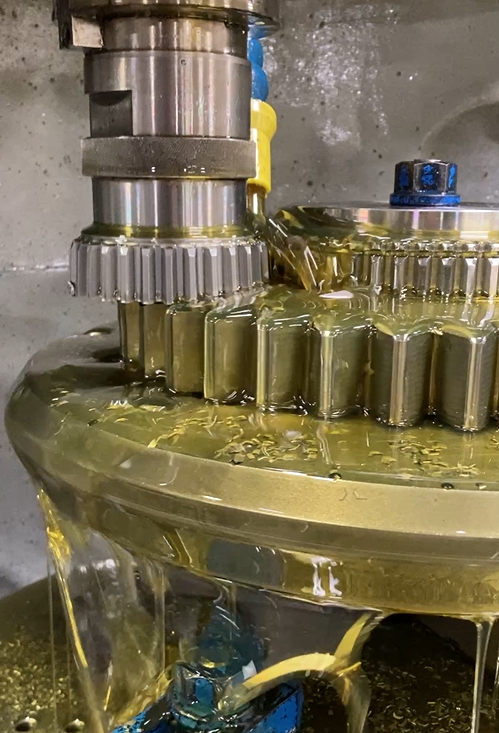
This video shows the gear hobbing process. The hob constantly has lubrication oil poured over it as it cuts into the rotating gear being produced.
Lawler Gear also uses CNC gear hobbers as part of our gear-cutting capabilities, allowing hobbing to be used for a variety of custom gear manufacturing projects.
Gear Hobbing Applications
Gear hobbing is commonly associated with external gears, where the teeth are located around the outside circumference of the gear.
Typical applications include:
- Spur Gears: Straight teeth running parallel to the gear axis
- Helical Gears: Angled teeth that provide smoother engagement than spur gears
- Production Runs: The continuous cutting process can be efficient when producing multiple similar gears.
- Custom Industrial Gears: Hobbing can be used when ordering a custom gear, as long as the gear’s geometry is suited to the process.
Hobbing can produce a range of external gear configurations, but it is generally not suited to cutting teeth on the inside of a gear.
Internal gearing requires a different approach, which is where gear shaping comes in.
Gear Shaping: How It Works & Where It’s Used
How Does Gear Shaping Work?
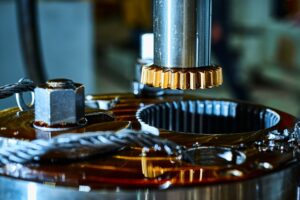
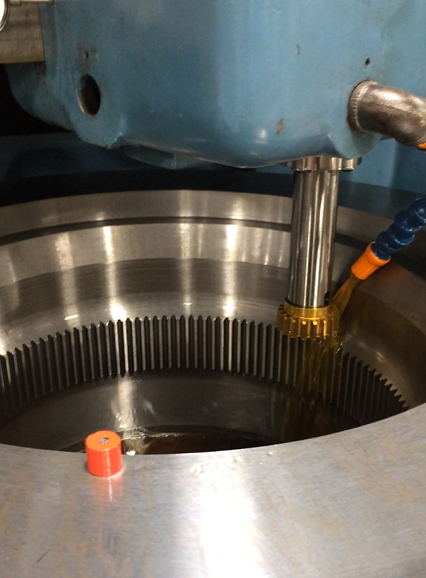
Gear shaping uses a cutter that resembles a gear or pinion. Instead of continuously rotating through the cut like a hob, the shaping cutter moves back and forth in a reciprocating motion.
The cutter and gear blank also rotate together in a controlled relationship. With each cutting stroke, the cutter removes material until the complete tooth profile is generated.
This process is as follows:
- The gear blank is positioned on the shaping machine.
- The cutter moves through repeated cutting strokes.
- The cutter and gear blank rotate in coordination.
- Each stroke removes a small amount of material.
- The repeated cuts gradually form the gear teeth.
This reciprocating cutting motion allows the cutter to reach configurations that are difficult or impractical to manufacture through conventional hobbing.
Lawler Gear uses Fellows gear shapers among its gear-cutting equipment, giving us the ability to use shaping for gear designs that are better suited to a reciprocating cutter.
The Applications of Gear Shaping
The most important application of gear shaping is internal gears. Instead of having teeth around the outside of the gear, an internal gear has teeth cut into the inside circumference of a ring.
Because the shaping cutter can work inside the gear, it can create this internal tooth profile. Standard gear hobbing typically can’t perform this operation in the same way.
Gear shaping can also be used for external gears. Depending on the part’s geometry, size, accessibility, and manufacturing requirements, shaping may be a practical way to produce an external gear as well.
This makes shaping more than just an alternative to hobbing. It gives manufacturers another way to produce gear teeth when the configuration of the part calls for a different cutting method.
Gear Shaping vs. Gear Hobbing: 3 Key Differences
The two processes share the same basic goal: generating accurate gear teeth. The biggest difference is how the cutting tool moves and interacts with the gear blank.
| Factor | Gear Hobbing | Gear Shaping |
| Cutting tool | Rotating hob | Pinion-shaped cutter |
| Cutting motion | Continuous rotary cutting | Repeated reciprocating strokes |
| External gears | Commonly used | Can be used |
| Internal gears | Not suited | Well suited |
| Cutting action | Continuous | Repeated strokes |
| Common applications | External spur and helical gears | Internal gears and certain external gears |
1. Cutting Motion
The biggest mechanical difference in these processes is the way the cutting tools move.
A gear hob rotates continuously while the gear blank rotates in coordination with it. The hob’s multiple cutting edges progressively shape the teeth as the two components move together.
A gear shaping cutter moves back and forth while also maintaining a precise rotational relationship with the gear blank. The repeated strokes gradually form the tooth profile.
2. Internal vs. External Gears
The distinction becomes even more important when looking at the location of the gear teeth.
Hobbing is commonly used for external gears, including many spur and helical gear designs. The rotating hob engages the outside of the gear blank as the teeth are formed.
Shaping is particularly useful for internal gears because the cutter can operate inside the ring to create the internal tooth profile. This is one of the clearest practical differences between the two processes.
Both methods can overlap when manufacturing certain external gears, but their capabilities are far from identical.
3. Production & Geometry
The design of the gear also affects which process is practical. Hobbing’s continuous cutting action can make it an efficient method for many external gear applications, particularly when producing multiple similar parts.
Shaping can provide greater flexibility when the gear’s design makes hobbing impractical or even impossible. The process is especially valuable when internal teeth are required, but it can also be used for some external gear designs.
The important point is that gear hobbing and gear shaping are actually complementary processes. Neither one is better or worse than the other, because each provides capabilities that can be useful depending on the gear being manufactured.
Gear Shaping & Gear Hobbing at Lawler Gear
Choosing the right gear-cutting process depends on the gear’s design, configuration, and manufacturing requirements. Lawler Gear offers both gear hobbing and gear shaping, giving our team the flexibility to work with different gear types and applications.
With additional capabilities, including CNC turning and milling, gear grinding, and precision inspection, Lawler can support multiple stages of the gear manufacturing process.
Need a custom gear manufactured? Contact Lawler Gear to discuss your industrial gear design and manufacturing requirements.